
How to Source the Best Green Fabrics for Your Business?
Choosing green fabrics is not a simple matter of picking a natural-looking swatch. The decision affects product quality, supplier transparency, cost, and the claims your business can responsibly make. Textile Exchange’s Materials Market Report 2024 estimates global fiber production reached 124 million tonnes in 2023. It projects production could rise to 160 million tonnes by 2030. That growth makes material choices more consequential. But a “green” label alone proves little.
A recycled fiber may reduce reliance on virgin resources, yet its impacts still depend on production, processing, durability, and end-of-life options. Organic, recycled, and regenerative materials are not interchangeable. The details matter. Fashion Revolution co-founder Orsola de Castro has said, “The most sustainable garment is the one already in your wardrobe.” Her reminder is useful, though it is not a sourcing specification. For a buying team, the practical question is whether a fabric performs well enough to make products customers will use for years.
This guide explores how to assess green fabrics with evidence, not just attractive swatches or supplier promises. Ask for current certifications and traceability documents. Check fiber composition, dyeing and finishing processes, minimum order quantities, and test results for shrinkage, colorfastness, and abrasion. Compare suppliers using the same criteria. And, honestly, even careful buyers can miss a weak link in a supply chain. No single certificate answers every question. The goal is to make a defensible choice, document its limits, and keep improving with each order.
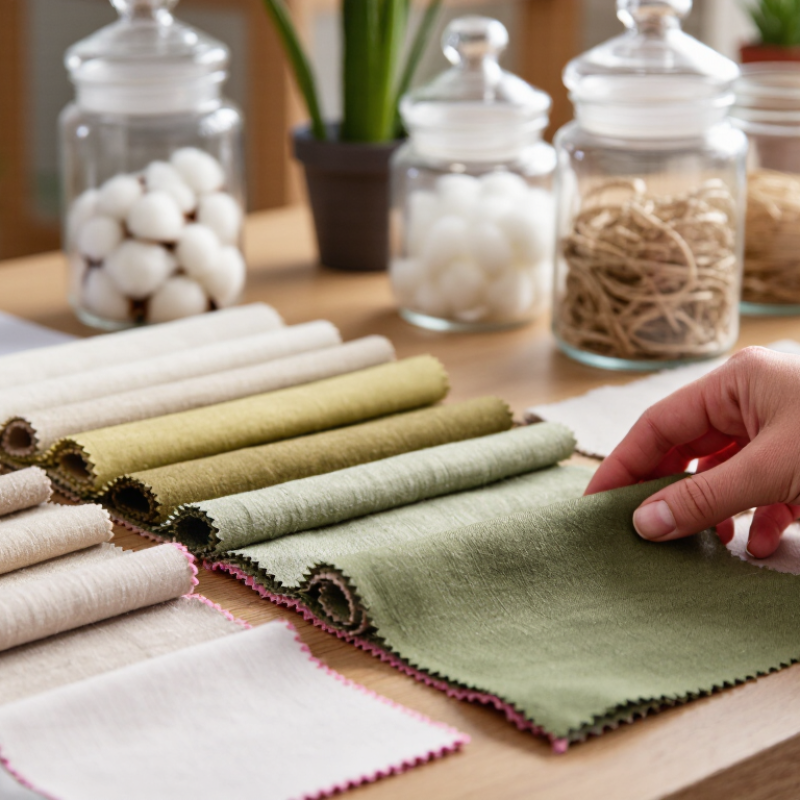
Define Your Business’s Sustainability and Fabric Requirements
Before requesting “green fabric,” define what sustainability means for your business. Is the priority lower-impact fiber, verified recycled content, long service life, or traceable production? Textile Exchange’s Materials Market Report 2024 estimates global fiber production reached 124 million tonnes in 2023, with polyester accounting for 57%. That scale matters. A vague preference can leave suppliers guessing.
Write a measurable brief. Specify fiber composition, target recycled or organic content, acceptable certifications, and required supply-chain records. Set performance needs too: intended garment, fabric weight, stretch, colorfastness, and expected wash cycles. A lightweight lining and a hard-wearing uniform need different materials. Some requirements may conflict. Our brief may need revision.
Ask suppliers for test results and transaction-level evidence, not just broad sustainability claims. Check whether certification scope covers the exact material and processing stage you plan to buy. Request sample yardage, then test shrinkage, pilling, and color after washing. Record the results alongside price and minimum order quantities. A fabric that fails early can waste material, time, and money.
Define Your Business’s Sustainability and Fabric Requirements
Minimum recycled-content thresholds can help you turn sustainability goals into clear fabric-sourcing specifications.
RCS certification applies to products containing at least 5% recycled material. GRS certification requires at least 20%; GRS product labeling requires at least 50%. Confirm current requirements with Textile Exchange before specifying or making claims.
Compare Green Fabric Types and Their Environmental Trade-Offs
Choosing a green fabric means comparing impacts, not chasing a single “best” label. Textile Exchange’s Materials Market Report 2024 estimates that global fiber production reached 124 million tonnes in 2023. Polyester made up 57% of that volume. Scale matters.
Organic cotton can reduce reliance on synthetic pesticides, but its land and water demands vary by farm and climate. Rain-fed cotton and irrigated cotton are not equivalent. Linen and hemp can need less irrigation in some growing regions, yet retting, dyeing, and finishing still affect their footprint. Ask suppliers where fibers were grown and processed.
Recycled polyester reduces demand for virgin fossil feedstocks, but it remains a synthetic fiber. The same report puts recycled material at about 12.5% of polyester production in 2023; recycled content alone does not prove low overall impact. The European Environment Agency’s 2022 report on microplastics from textiles also highlights fiber shedding as a concern. Not a free pass. For a real comparison, request verified composition and traceability records, then test fabric samples after washing and wear. A soft swatch can conceal pilling, shrinkage, or a finish that complicates recycling. We often overlook those details.
| Fabric type | Typical feedstock and production | Potential environmental advantages | Key trade-offs and limitations | Useful sourcing checks | Often suitable for |
|---|---|---|---|---|---|
| Organic cotton | Cotton grown under an organic agricultural standard; the fiber is then spun, knitted or woven, and finished. | Organic standards restrict most synthetic pesticides and fertilizers. It is a plant-based, biodegradable fiber when not combined with non-biodegradable components. | Organic does not automatically mean low water use: irrigation needs depend on location and farming practices. Dyeing and finishing can also contribute substantially to impacts. | Verify the organic claim with a current, recognized certification and confirm whether it covers the fiber, processing, or finished product. Ask about farm location, irrigation, dyeing, and wastewater management. | Everyday apparel, knitwear, bedding, and products where a natural hand feel is important. |
| Recycled cotton | Mechanical recycling of pre-consumer or post-consumer cotton textiles into recovered fiber, often blended with other fibers. | Uses recovered material and can reduce demand for virgin cotton. Mechanical recycling generally avoids growing new cotton for the recovered portion. | Mechanical processing can shorten fibers, limiting strength and often requiring blending with virgin fibers. Mixed-fiber waste is harder to recycle, and recycled content does not by itself establish product durability. | Request evidence of recycled content and identify whether it is pre-consumer or post-consumer. Check the actual percentage, fiber blend, traceability, and fabric performance after laundering. | Casualwear, denim, home textiles, and products that can accommodate recycled-fiber blends. |
| Linen (flax) | Made from flax stems. The stalks are processed to separate fibers, which are spun and woven or knitted. | Flax can be rain-fed in suitable regions and generally requires less irrigation than cotton there. The whole plant can be used in multiple ways. | Impacts depend on growing conditions, retting method, processing, and finishing. Water retting can create wastewater-management needs; linen can wrinkle and may require care choices that affect product life. | Ask where the flax was grown and processed, whether irrigation was used, how retting wastewater is handled, and what chemicals or finishes are applied. | Shirts, trousers, summer clothing, towels, and home textiles where a textured, breathable fabric is desired. |
| Hemp | Fiber from the stalks of industrial hemp plants; processing separates and prepares the fibers for spinning and fabric production. | Hemp can grow with relatively low pesticide inputs in some production systems and can produce useful fiber from a fast-growing crop. | Water, fertilizer, and pesticide needs still vary by region and farm. Fiber processing and fabric finishing affect impacts, while coarse fibers may require additional processing or blending for a softer hand. | Check the growing region, agricultural inputs, retting and fiber-processing methods, blend composition, and any softening or finishing treatments. | Workwear, durable casualwear, canvas-style products, and blended fabrics. |
| Lyocell | Regenerated cellulose made from wood pulp using a solvent-based process; some production systems recover and reuse most of the process solvent. | Can use renewable cellulose feedstock, and solvent recovery can reduce process losses compared with less-controlled methods. The fabric is often soft and drapey. | Environmental performance depends on forest sourcing, pulping, energy, solvent recovery, and wastewater controls. “Cellulosic” alone does not prove responsible forestry or cleaner processing. | Verify responsible and traceable wood sourcing, ask for process-specific information on solvent recovery and emissions, and review chemical and wastewater controls. | Dresses, shirts, linings, soft knitwear, and products requiring a smooth drape. |
| Recycled polyester | Usually made from recycled PET, such as bottles or textile waste, which is processed into polyester fiber. | Can displace some virgin fossil-based polyester and make use of recovered PET. It is durable and quick-drying in many fabric constructions. | It remains a synthetic fiber and can release microfibers during use and washing. Bottle-to-fiber recycling may divert material from bottle-to-bottle recycling, and recycling does not guarantee recyclability at end of life. | Confirm recycled-content percentage and feedstock source. Assess shedding, fabric durability, care instructions, and whether the product has a realistic end-of-life route. | Activewear, outerwear, bags, and products where strength or quick drying is needed. |
| Responsible wool | Animal fiber shorn from sheep, then scoured, spun, and made into fabric or knitwear. | Long-lasting wool garments can have a long service life, and wool is biodegradable under suitable conditions when free from persistent synthetic blends and finishes. | Sheep produce methane, and land, feed, water, and manure impacts vary by farm. Animal welfare, land management, scouring, and blended construction also matter. | Review farm-level animal-welfare and land-management evidence, traceability, scouring wastewater controls, and any treatments or blends used. | Coats, knitwear, suiting, and temperature-regulating products designed for repeated wear. |
How to compare: These are general material-level considerations, not a universal ranking. Actual impacts vary with farm or feedstock origin, manufacturing energy, dyeing and finishing, fabric weight, durability, care, and end-of-life options. For major purchasing decisions, compare equivalent products using product-specific life-cycle data and verified supply-chain documentation.
Find Suppliers and Verify Their Certifications and Traceability
When sourcing green fabrics, ask potential suppliers to identify the mill, dyehouse, and finishing facility—not only the sales office. Request current certificates and check that each one covers the specific material and processing site you plan to use. A certificate for one product does not automatically apply to another. Small detail, big difference.
Ask for transaction records, purchase documents, and lot numbers that connect the finished fabric to its claimed fibre source. Depending on the material, relevant schemes may include GOTS, OCS, or GRS. Verify certificates directly with the issuing organization when possible, and check their validity dates and scope. For recycled or organic claims, ask what evidence supports the stated percentage. Clear answers should match across documents.
Traceability should work in both directions. Give a fabric lot number and ask the supplier to show where it came from; then ask how a finished roll can be traced back through processing. Paper trails can still contain gaps. This process can feel repetitive, and it is easy to accept a polished PDF too quickly. I would rather pause over a missing dyehouse record than assume the claim is complete. Ask how often records are updated, and keep the evidence alongside your order documents.
Test Fabric Samples for Quality, Performance, and Cost
How to Source the Best Green Fabrics for Your Business?
A fabric swatch can feel soft and still fail after washing. Test samples under conditions close to real use. Measure shrinkage, color change, pilling, and seam strength. For a fabric intended for repeated wear, wash it several times and compare it with an untreated sample. Record the settings and results; otherwise, comparisons can become guesswork. Ask suppliers for fiber composition and supporting environmental documentation, then check that the information matches the sample.
Tips: Keep a simple test log. Note sample date, weight, width, quoted price, and test results. Request enough yardage for a small cut-and-sew trial, not just a hand-sized swatch. Check whether the quoted cost includes finishing, shipping, and likely cutting waste.
Performance and cost belong together. A lower price per meter may not mean lower cost per finished item if the fabric shrinks or defects reduce usable yield. Inspect the cloth in daylight and under indoor lighting. A useful test, but not a perfect one: lab conditions and factory production can differ. Before committing, ask for a production-representative sample and confirm lead time and minimum order quantity. Even then, allow room for surprises. One overlooked finish can change the hand feel or care needs.
Establish a Reliable and Responsible Sourcing Plan
How to Source the Best Green Fabrics for Your Business?
Establish a Reliable and Responsible Sourcing Plan
Reliable green-fabric sourcing starts with a written specification, not a broad “sustainable” claim. Define fiber content, recycled or organic share, dyeing requirements, expected volume, and acceptable price range. Ask suppliers for invoices, transaction certificates, and chain-of-custody documents that match the exact fabric and production lot. Ask for evidence. A certificate alone may not prove that every shipment meets your requirements.
Textile Exchange’s Materials Market Report 2024 estimates that global fiber production reached 124 million tonnes in 2023. Recycled fibers made up only 7.7% of the market. That gap makes clear documentation essential: request the recycled-content percentage and its calculation method, then check that supporting records cover the material you are buying. Where claims rely on organic or recycled content, use relevant independent certification and confirm its scope directly.
Test samples before placing a bulk order. Rub a swatch with a damp white cloth, check shrinkage after washing, and compare its color under daylight and indoor lighting. Small details matter. Record test results by fabric code and production lot, and keep an approved sample for later comparison. Ask suppliers about mill location, subcontracting, water and chemical controls, and how they handle rejected batches. Some data may remain incomplete; note the gaps, set a date for follow-up, and avoid treating an unanswered question as proof of good practice.
Related Posts
-
2026 Best Textile Treatment Techniques for Global Buyers?
-

Top Textile Machinery Manufacturers Worldwide?
-

2026 Best Fabric Weaving Techniques and Innovations for Textile Industry?
-
What is a Fabric Weaving Machine and How Does It Work?
-

Top 10 Textile Treatment Techniques You Should Know?
-

Top Carbon Weaving Machine Innovations Transforming the Industry?